Publications

I study how education policies and programs affect students, and, critically, which students they affect most.

Four themes run through this work. Much of my recent research focuses on out-of-school and disrupted learning: the COVID-19 pandemic's toll on achievement, summer learning loss, and whether recovery interventions can close the gap. A second line examines accountability, how federal and state policies like NCLB, ESEA waivers, and ESSA shape school and teacher quality. I also study exclusionary practices: discipline disparities, curricular tracking, and how school structures deepen segregation. Finally, my work on school choice asks whether charters, virtual schooling, and choice markets improve outcomes or simply reshuffle them.

Out-of-School or Disrupted Learning (24 publications) This line of research examines what happens to student learning outside the traditional school year and during periods of disruption. My work documents summer learning loss patterns, evaluates the effectiveness of summer school programs, and studies the educational consequences of the COVID-19 pandemic, including the impact of remote instruction and academic recovery interventions.
Journal Article

Impacts of Academic Recovery Interventions on Student Achievement in 2022-23

COVID catch-up programs promised a lot but delivered less than hoped. Across eight school districts in 2022-23, most programs reached fewer students than planned and produced few measurable gains. The exception: intensive interventions like subject-specific tutoring, small-group reading, and placement with highly effective teachers actually moved the needle. The lesson is clear but humbling: intensive support works, it's just really hard to pull off at scale.
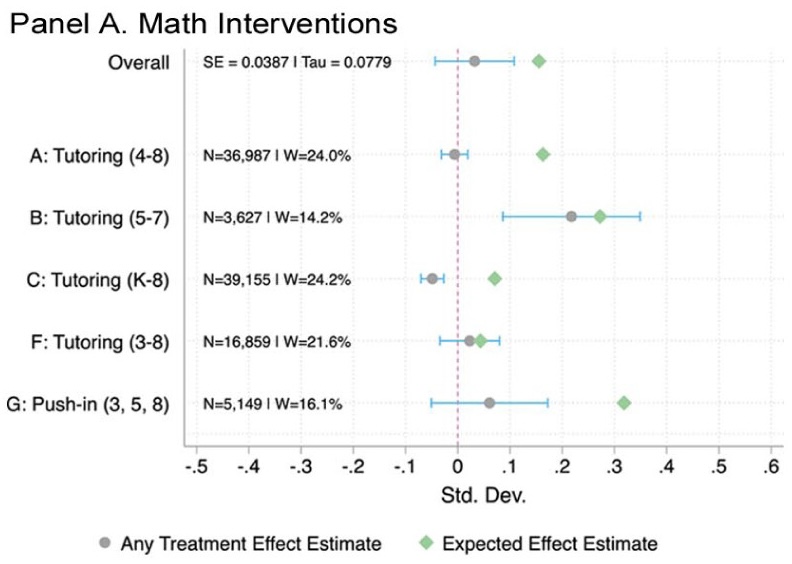
Carbonari, M.V., DeArmond, M., Dewey, D., Dizon-Ross, E., Goldhaber, D., Kane, T.J., McDonald, A., McEachin, A., Morton, E., Muroga, A., Salazar, A., & Staiger, D.O. (Accepted). Impacts of Academic Recovery Interventions on Student Achievement in 2022-23. Educational Evaluation and Policy Analysis.
Impacts of Academic Recovery Interventions on Student Achievement in 2022-23
Journal Article

Summer School as a Learning Loss Recovery Strategy After COVID-19: Evidence from Summer 2022

Summer school seemed like an obvious fix for pandemic learning loss, and many districts doubled down on it. But a look at eight districts serving 400,000 students tells a more sobering story. Attendance was low (only 13% of students participated), and the academic gains were modest at best: a small positive effect in math, and nothing measurable in reading. The bottom line: summer school helped the students who showed up, but with so few attending, it barely made a dent in overall pandemic losses.
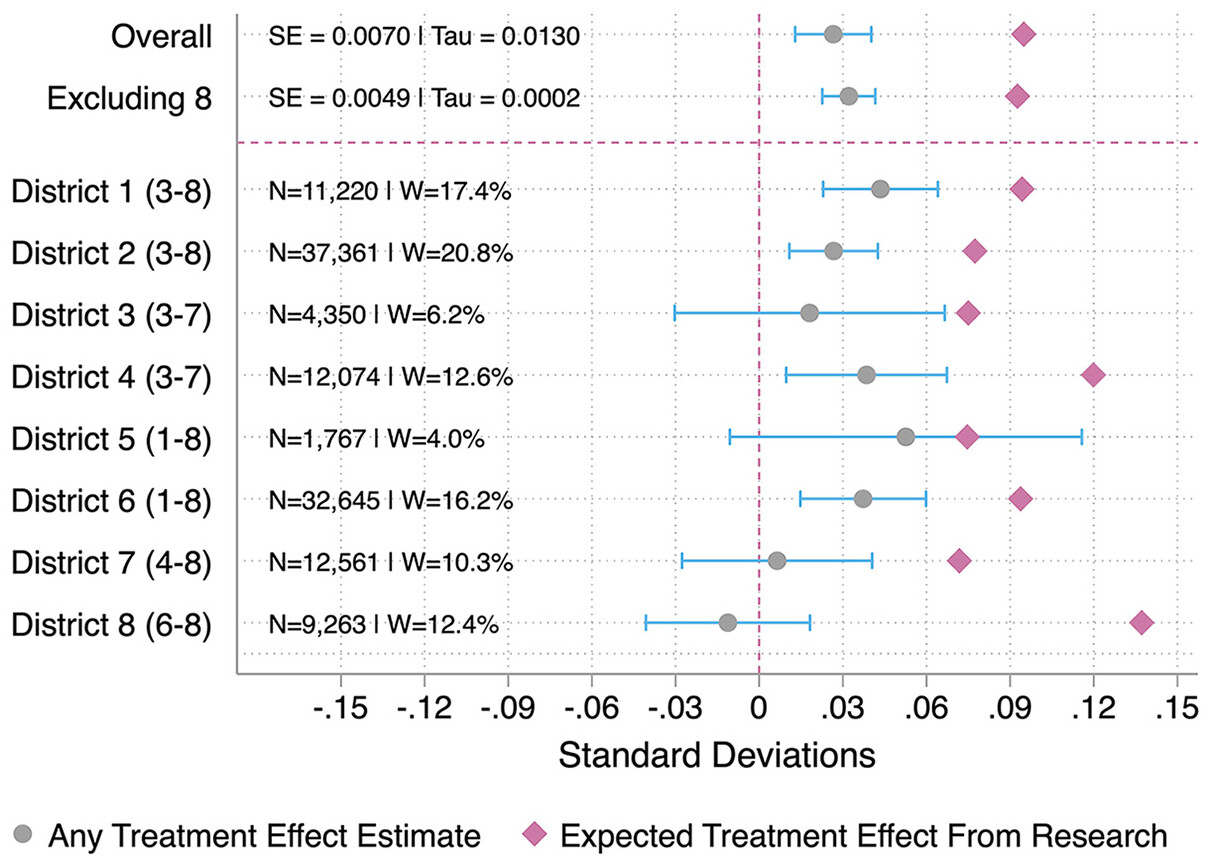
Callen, I., Carbonari, M.V., DeArmond, M., Dewey, D., Dizon-Ross, E., Goldhaber, D., Isaacs, J., Kane, T.J., Kuhfeld, M., McDonald, A., McEachin, A., Morton, E., Muroga, A., & Staiger, D.O. (2025). Summer School as a Learning Loss Recovery Strategy After COVID-19: Evidence from Summer 2022. American Educational Research Journal, 62(5), 982-1018.
Summer School as a Learning Loss Recovery Strategy After COVID-19: Evidence from Summer 2022
Journal Article

Combined Schools as a (Non) Protective Factor During the COVID-19 Pandemic: Exploring Middle School Transitions Under Typical versus Atypical School Conditions

Combined K-8 schools have long been seen as a smoother path through middle school, sparing students the jarring transition to a new building and culture. And the data backed this up, until the pandemic hit. Looking at 20,000 students, we found that K-8 schools' academic edge largely evaporated during COVID, especially for students learning remotely. The takeaway: the stability these schools provide is real and valuable, but it depends on actually being in the building. When that's gone, so is much of the advantage.
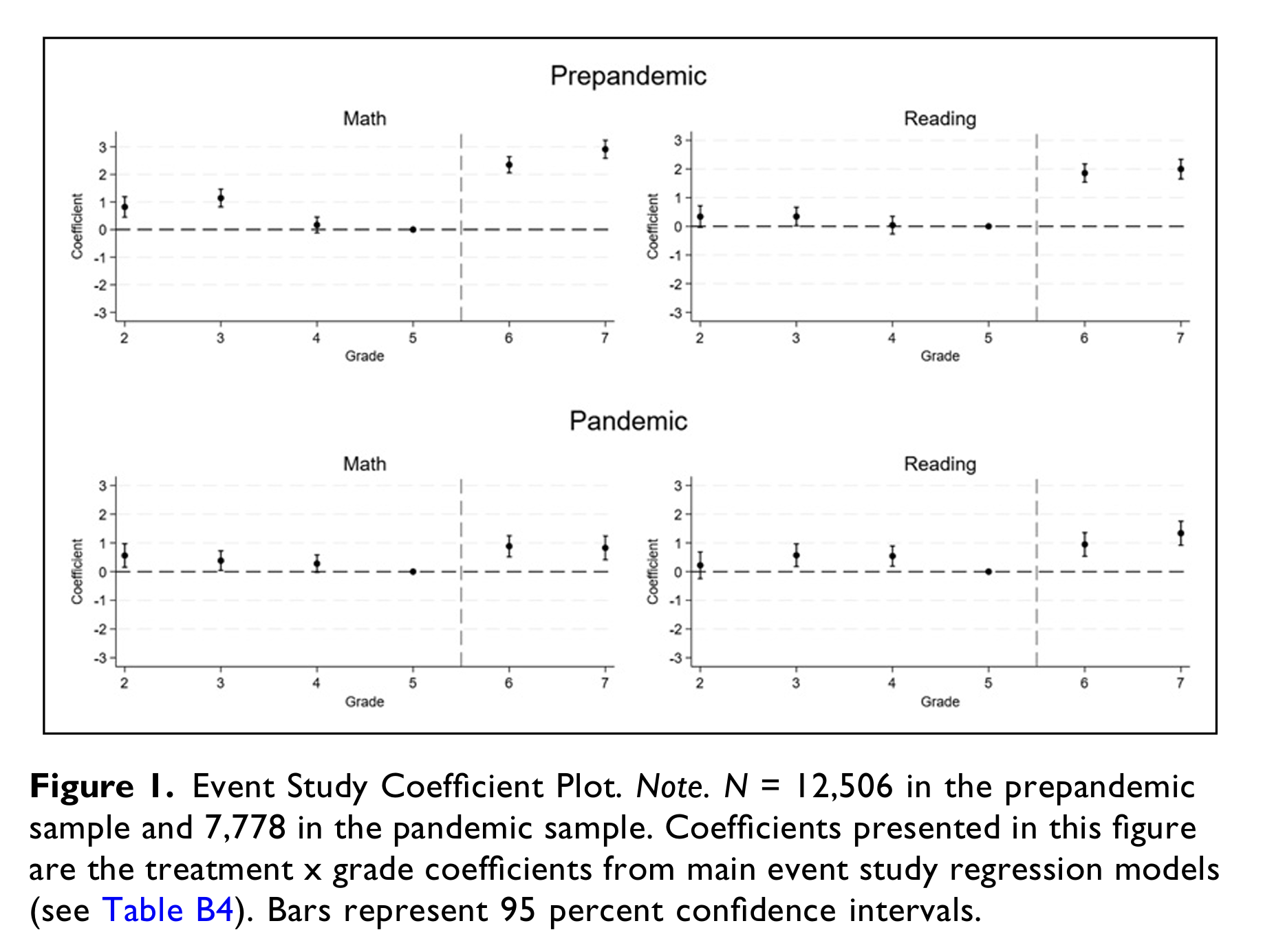
Diliberti, M.K., Schweig, J.D., Mariano, L.T., Kuhfeld, M., & McEachin, A. (2025). Combined Schools as a (Non) Protective Factor During the COVID-19 Pandemic: Exploring Middle School Transitions Under Typical versus Atypical School Conditions. Journal of Early Adolescence, 46(2), 278-305.
Combined Schools as a (Non) Protective Factor During the COVID-19 Pandemic: Exploring Middle School Transitions Under Typical versus Atypical School Conditions
Working Paper

Summer School as an Academic Recovery Strategy After COVID-19: Evidence From Summer 2023

Summer school is back for round two, and the results are cautiously encouraging. Across eight large districts serving 400,000 students, 2023 summer programs again produced modest but real gains in math, while reading remained stubbornly flat. One bright spot: students who attended for a second consecutive summer did just as well, or better, than first-timers. That's good news for districts betting on summer school as a long-term recovery strategy. It won't close the gap overnight, but it keeps working for kids who keep showing up.
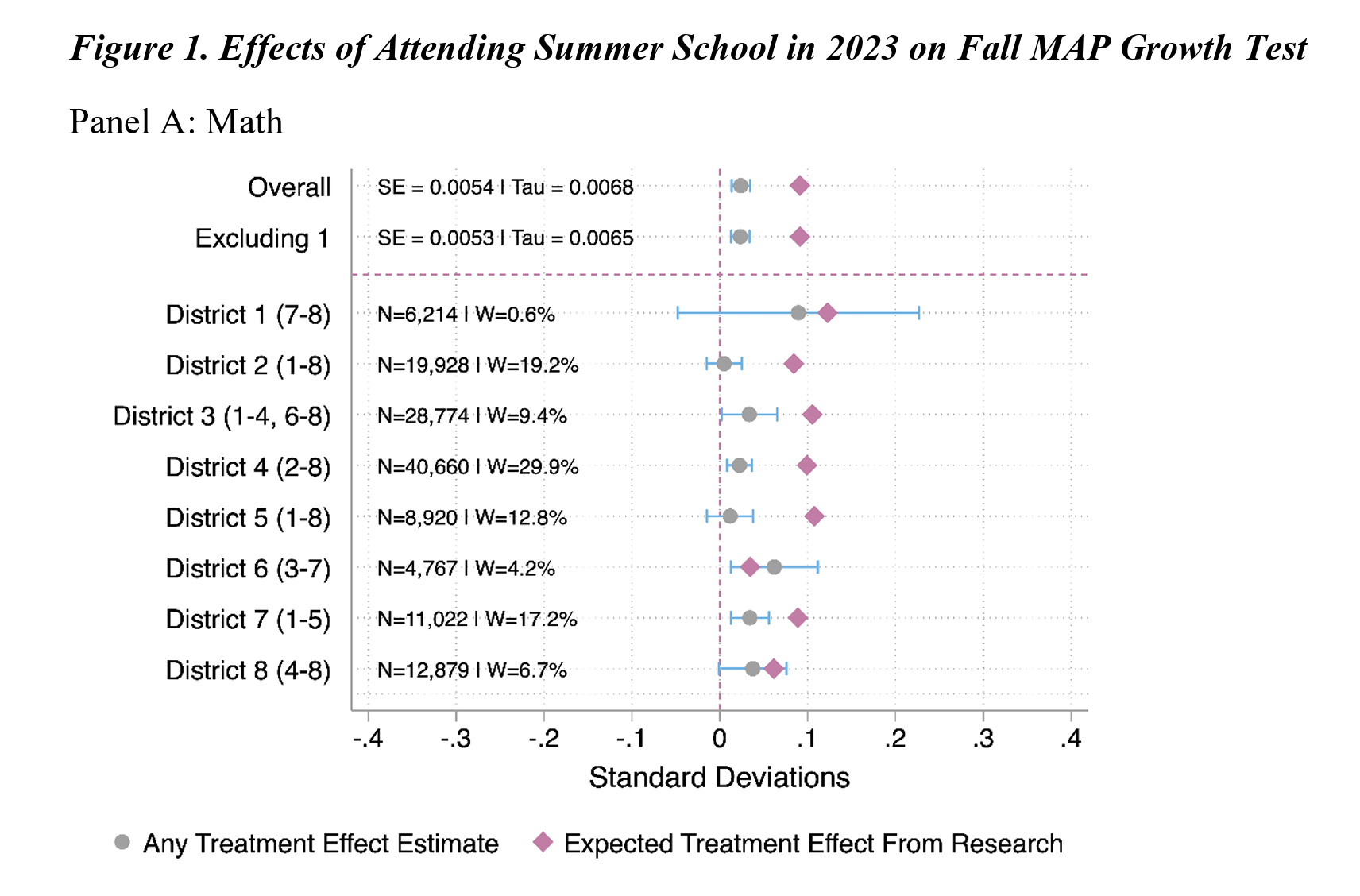
Bolyard, A., DeArmond, M., Dizon-Ross, E., Goldhaber, D., Isaacs, J., Kane, T., Keating, M., Klinenberg, J., McDonald, A., McEachin, A., Morton, E., Muroga, A., Salazar, A., & Staiger, D.O. (2025). Summer School as an Academic Recovery Strategy After COVID-19: Evidence From Summer 2023.
Summer School as an Academic Recovery Strategy After COVID-19: Evidence From Summer 2023
Report

Implementing programs to align, accelerate, and extend student learning

Districts spent billions of ESSER dollars on three recovery strategies backed by strong pre-pandemic evidence: ELA curriculum, high-dosage tutoring, and summer programs. But running these programs during an ongoing crisis, at a scale no one had attempted, exposed familiar problems: too few staff, too little coordination, and contexts that didn't match the original research. These strategies can improve student learning. The hard part is building the conditions for them to actually work.
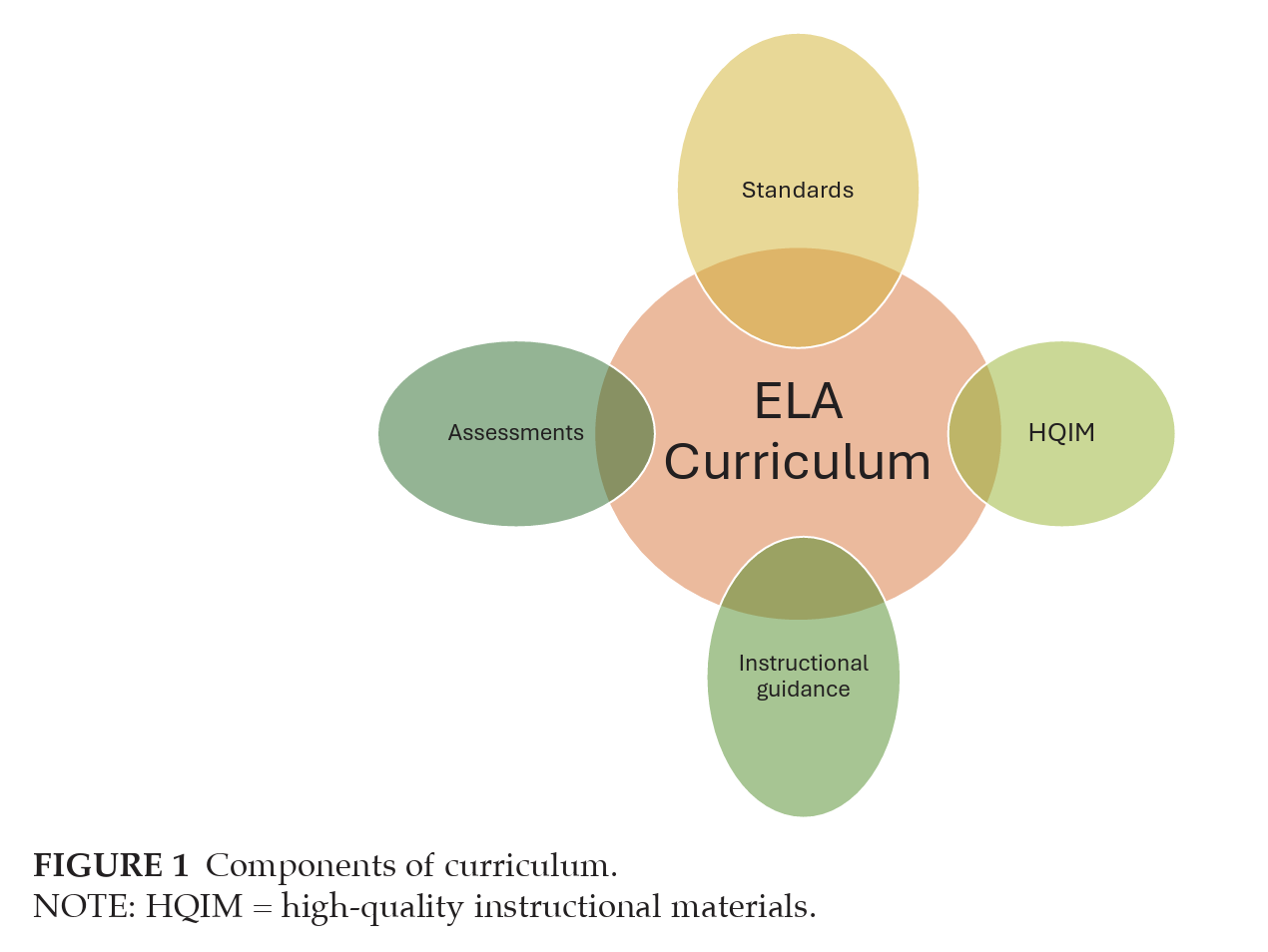
Kuhfeld, M., Woulfin, S.L., & McEachin, A. (2025). Implementing programs to align, accelerate, and extend student learning. National Academy of Education.
Implementing programs to align, accelerate, and extend student learning
Journal Article

The Impact and Implementation of Academic Interventions During COVID-19: Evidence from the Road to Recovery Project

Four large districts rolled out tutoring, small-group instruction, and extended learning time during 2021-22 to help students recover from pandemic losses. The programs reached fewer students than planned and produced little measurable effect on math or reading scores. District leaders traced the shortfall to staffing gaps, scheduling conflicts, and programs that couldn't operate at the intensity the research says they need.
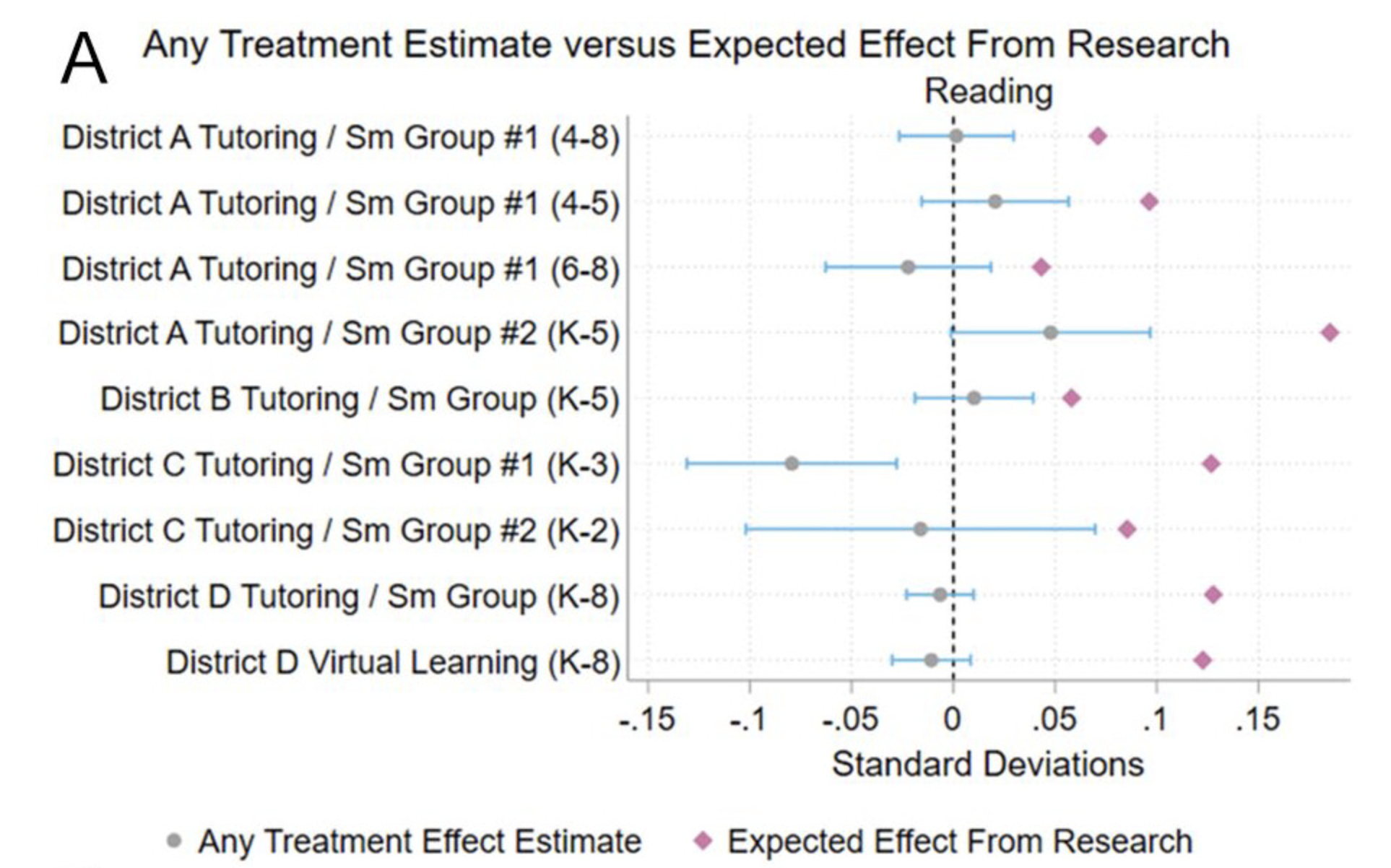
Carbonari, M.V., Davison, M., DeArmond, M., Dewey, D., Dizon-Ross, E., Goldhaber, D., Hashim, A., Kane, T.J., McEachin, A., Morton, E., Patterson, T., & Staiger, D.O. (2024). The Impact and Implementation of Academic Interventions During COVID-19: Evidence from the Road to Recovery Project. AERA Open, 10(1), 1-18.
The Impact and Implementation of Academic Interventions During COVID-19: Evidence from the Road to Recovery Project
Journal Article

Testing an explanation for summer learning loss: Differential examinee effort between spring and fall

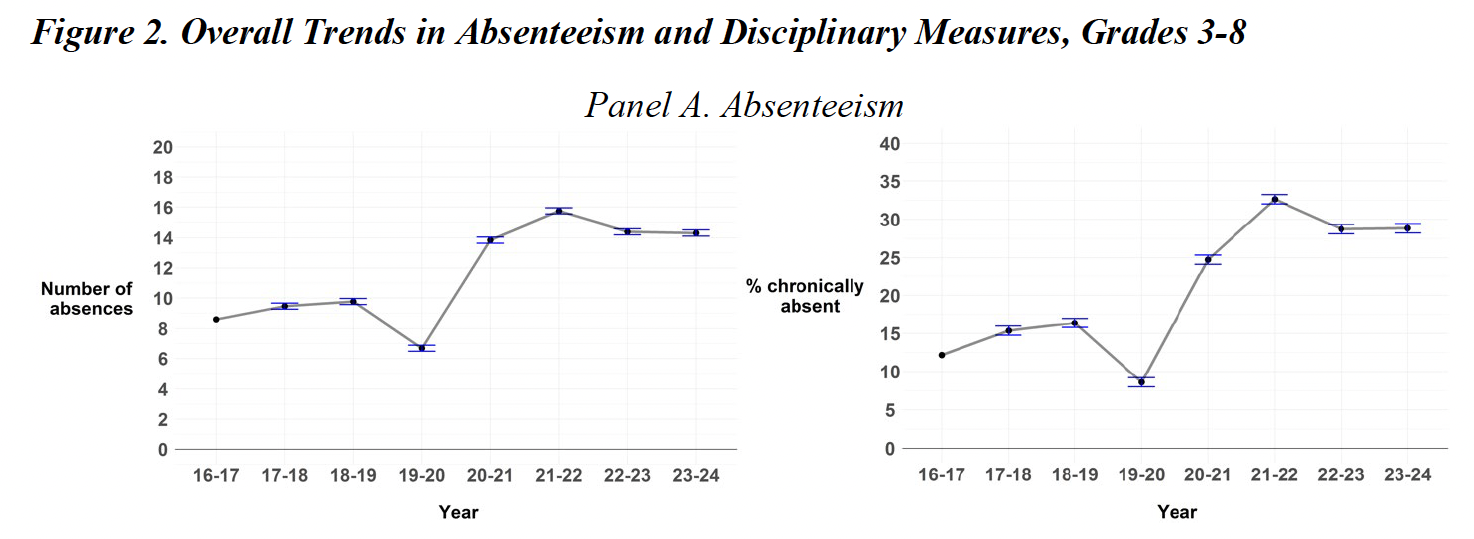
Every fall, teachers brace for the "summer slide" as students return having forgotten much of what they learned. But some researchers have pushed back, arguing that the dip might be a measurement illusion: maybe kids just don't try as hard on fall tests as spring tests. We put that critique to the test, and while we can't say definitively that summer learning loss is real, we also found no evidence that low effort on fall tests is what's driving the pattern. The summer slide remains a genuine puzzle, but this particular explanation doesn't hold up.
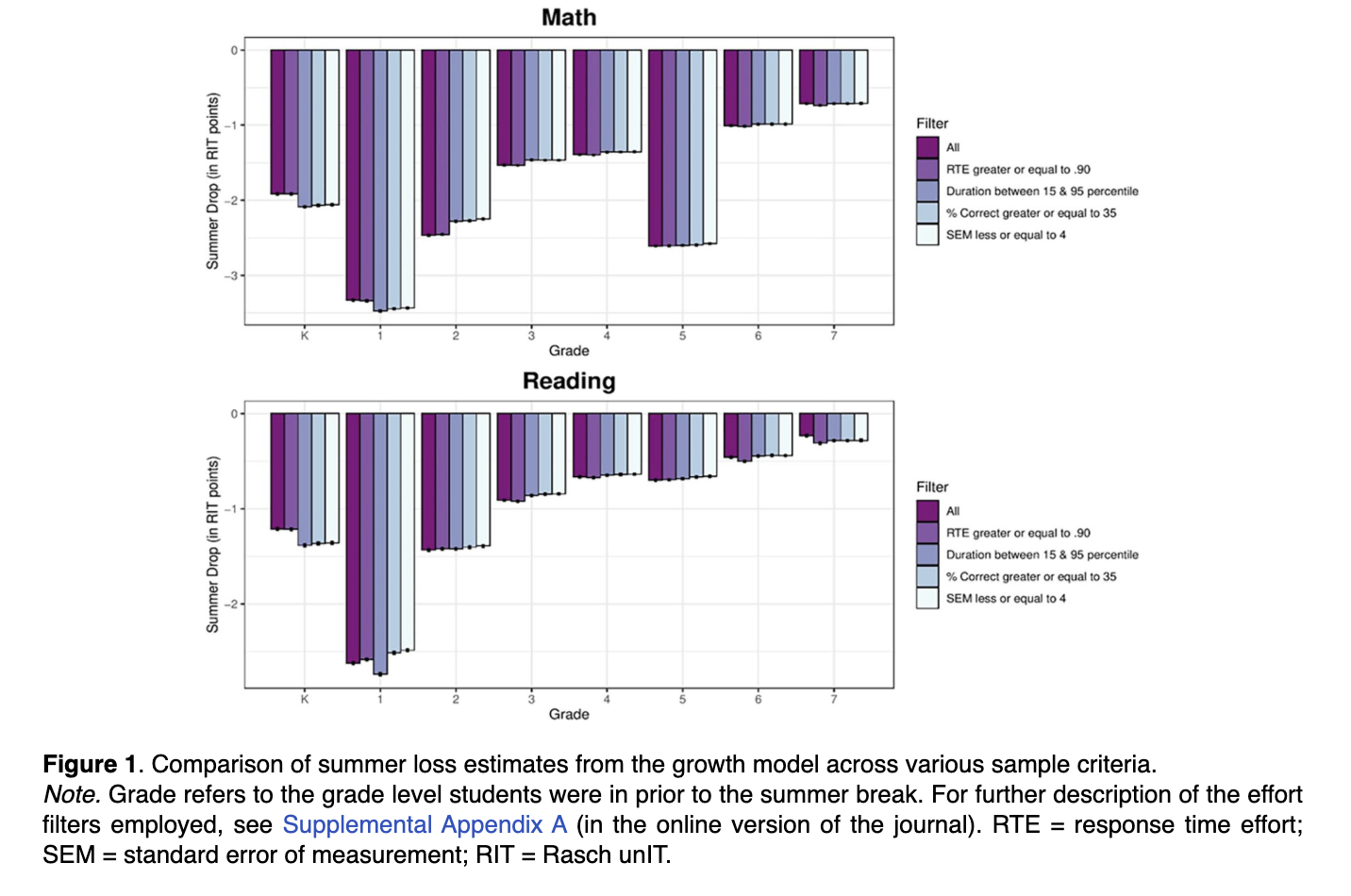
Kuhfeld, M., Soland, J., Register, B., & McEachin, A. (2024). Testing an explanation for summer learning loss: Differential examinee effort between spring and fall. Educational Evaluation and Policy Analysis, 46(3), 581-590.
Testing an explanation for summer learning loss: Differential examinee effort between spring and fall
Working Paper

Pandemic Learning Loss by Student Baseline Achievement: Extent and Sources of Heterogeneity

The pandemic hit hardest for students who were already behind, and the gap between lower- and higher-achieving students widened significantly. But the more striking finding is what drove that widening: the school a student attended explains about three-quarters of the achievement gap growth in math. Pandemic learning loss wasn't just about individual circumstances. School and district decisions mattered enormously, which means targeted, school-level recovery strategies aren't just helpful, they're essential.
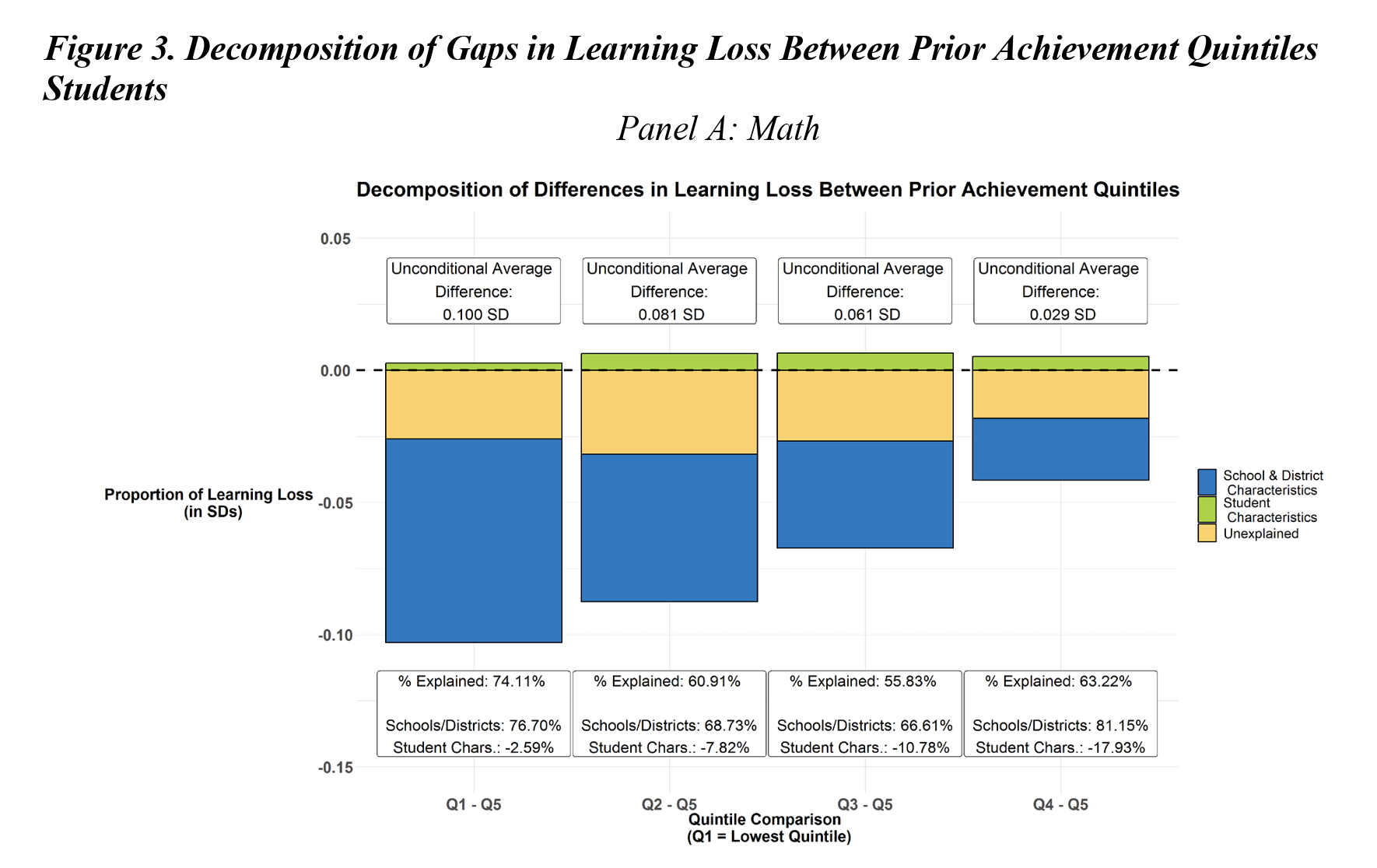
Callen, I., Goldhaber, D., Kane, T.J., McDonald, A., McEachin, A., & Morton, E. (2024). Pandemic Learning Loss by Student Baseline Achievement: Extent and Sources of Heterogeneity.
Pandemic Learning Loss by Student Baseline Achievement: Extent and Sources of Heterogeneity
Journal Article

The Educational Consequences of Remote and Hybrid Instruction During the Pandemic

We analyzed test scores from more than two million students across nearly 10,000 schools in every state to understand how remote learning widened achievement gaps by race and poverty. Remote instruction was the primary driver: math gaps didn't grow in places that stayed in person, though reading gaps widened everywhere. High-poverty districts that went remote now face a sobering reality, as pandemic learning loss may consume nearly all of their federal relief funding.
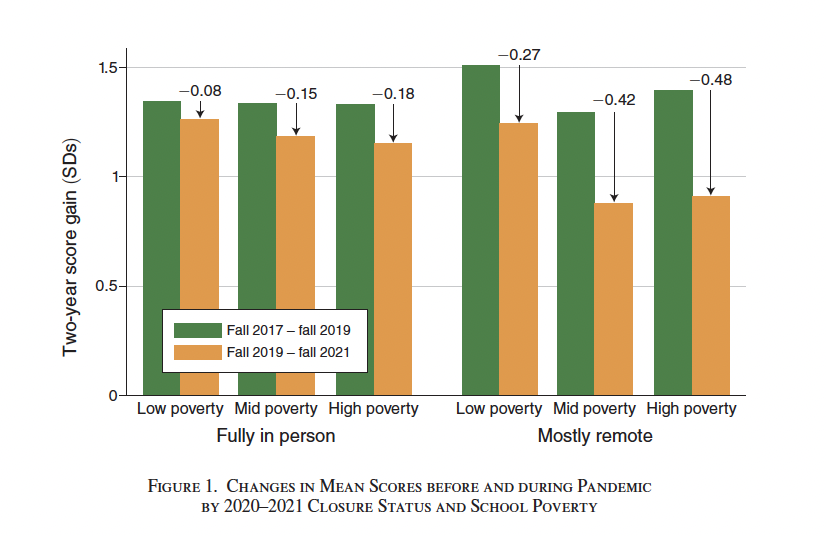
Goldhaber, D., Kane, T.J., McEachin, A., Morton, E., Patterson, T., & Staiger, D.O. (2023). The Educational Consequences of Remote and Hybrid Instruction During the Pandemic. American Economic Review: Insights, 5(3), 377-392.
The Educational Consequences of Remote and Hybrid Instruction During the Pandemic
Report

Typical learning for whom? Guidelines for selecting benchmarks to calculate months of learning

Headlines love to report pandemic learning loss in "months of learning," but that number is far more slippery than it sounds. The same test-score gap can translate into wildly different months depending on which benchmark you pick, which assessment you use, and which students you're comparing. We walk through the key choices researchers face when calculating this metric and show how each one can swing the results. The takeaway: months of learning can be a useful shorthand, but only if researchers are transparent about the assumptions baked into the denominator.
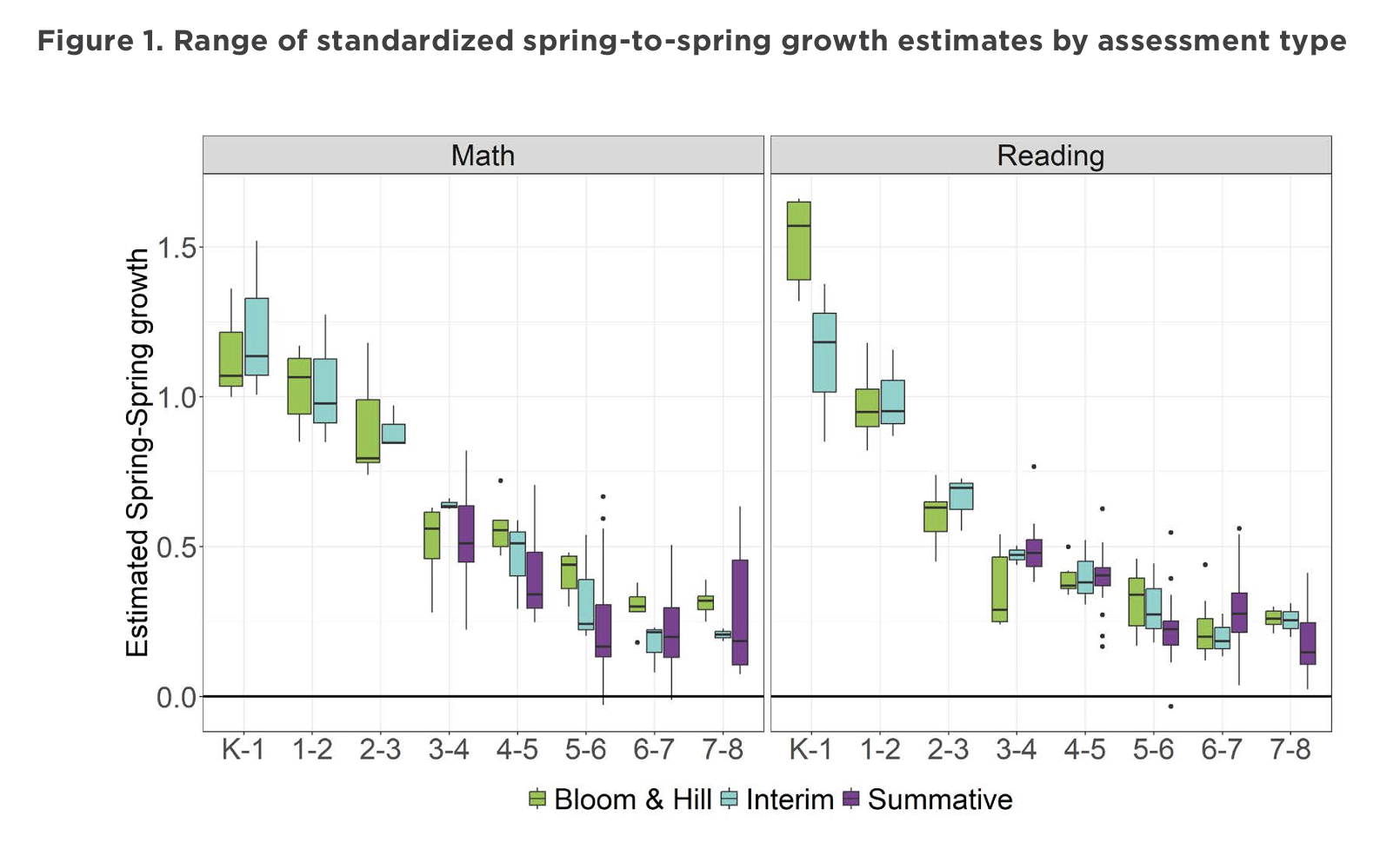
Kuhfeld, M., Diliberti, M., McEachin, A., Schweig, J., & Mariano, L.T. (2023). Typical learning for whom? Guidelines for selecting benchmarks to calculate months of learning. NWEA.
Typical learning for whom? Guidelines for selecting benchmarks to calculate months of learning
Report

Summer School as a Learning Loss Recovery Strategy After COVID-19: Evidence From Summer 2022

Callen, I., Carbonari, M.V., DeArmond, M., Dewey, D., Dizon-Ross, E., Goldhaber, D., Isaacs, J., Kane, T.J., Kuhfeld, M., McDonald, A., McEachin, A., Morton, E., Muroga, A., & Staiger, D.O. (2023). Summer School as a Learning Loss Recovery Strategy After COVID-19: Evidence From Summer 2022.
Journal Article

Allocating resources for COVID-19 recovery: a comparison of three indicators of school need

Schweig, J., McEachin, A., Kuhfeld, M., Mariano, L.T., & Diliberti, M.K. (2022). Allocating resources for COVID-19 recovery: a comparison of three indicators of school need. Educational Assessment, 27(2), 152-169.
Report

The Challenges of Implementing Academic COVID Recovery Interventions: Evidence from the Road to Recovery Project

Carbonari, M.V., Davison, M., DeArmond, M., Dewey, D., Dizon-Ross, E., Goldhaber, D., Hashim, A., Kane, T.J., McEachin, A., Morton, E., Patterson, T., & Staiger, D.O. (2022). The Challenges of Implementing Academic COVID Recovery Interventions: Evidence from the Road to Recovery Project.
Report

A Comprehensive Picture of Achievement Across the COVID-19 Pandemic Years: Examining Variation in Test Levels and Growth Across Districts, Schools, Grades, and Students

Goldhaber, D., Kane, T.J., McEachin, A., & Morton, E. (2022). A Comprehensive Picture of Achievement Across the COVID-19 Pandemic Years: Examining Variation in Test Levels and Growth Across Districts, Schools, Grades, and Students.
Report

Changes in School Composition During the COVID-19 Pandemic: Implications for School-Average Interim Test Score Use

Schweig, J., Kuhfeld, M., Diliberti, M., McEachin, A., & Mariano, L.T. (2022). Changes in School Composition During the COVID-19 Pandemic: Implications for School-Average Interim Test Score Use. RAND Corporation.
Journal Article

School's out: The role of summers in understanding achievement disparities

Atteberry, A., & McEachin, A. (2021). School's out: The role of summers in understanding achievement disparities. American Educational Research Journal, 58(2), 239-282.
Report

Learning during COVID-19: Reading and math achievement in the 2020-21 school year

Lewis, K., Kuhfeld, M., Ruzek, E., & McEachin, A. (2021). Learning during COVID-19: Reading and math achievement in the 2020-21 school year. NWEA.
Report

Adapting Course Placement Processes in Response to COVID-19 Disruptions

Schweig, J., McEachin, A., Kuhfeld, M., Mariano, L.T., & Diliberti, M.K. (2021). Adapting Course Placement Processes in Response to COVID-19 Disruptions. RAND Corporation.
Journal Article

Not where you start but how much you grow: An addendum to the Coleman Report

Atteberry, A., & McEachin, A. (2020). Not where you start but how much you grow: An addendum to the Coleman Report. Educational Researcher, 49(9), 678-685.
Journal Article

The impact of summer learning loss on measures of school performance

McEachin, A., & Atteberry, A. (2017). The impact of summer learning loss on measures of school performance. Education Finance and Policy, 12(4), 468-491.
Report

Learning from summer: Effects of voluntary summer learning programs on low-income urban youth

Augustine, C.H., McCombs, J.S., Pane, J.F., Schwartz, H.L., Schweig, J., McEachin, A., & Siler-Evans, K. (2016). Learning from summer: Effects of voluntary summer learning programs on low-income urban youth. RAND Corporation.
Book Chapter

School's out: Summer learning loss across grade levels and school contexts in the U.S. Today

Atteberry, A., & McEachin, A. (2016). School's out: Summer learning loss across grade levels and school contexts in the U.S. Today. In Alexander, K., Pitcock, S., & Boulay, M. (Eds.), The Summer Slide: What We Know and Can Do About Summer Learning Loss. Teachers College Press.
Book Chapter

What constitutes an effective summer learning program?

McEachin, A., McCombs, J., & Augustine, C. (2016). What constitutes an effective summer learning program?. In Alexander, K., Pitcock, S., & Boulay, M. (Eds.), The Summer Slide: What We Know and Can Do About Summer Learning Loss. Teachers College Press.
Book Chapter

An Endless Summer: The role of summer learning loss in school accountability policies

McEachin, A., & Atteberry, A. (2016). An Endless Summer: The role of summer learning loss in school accountability policies. In Gottfried, M., & Conchas, G. (Eds.), When School Policies Backfire: How Well-Intended Measures Can Harm Our Most Vulnerable Students. Harvard Education Press.
Accountability (22 publications) This research investigates how federal and state accountability policies shape educational quality. My work traces the evolution of accountability from No Child Left Behind through ESEA waivers to the Every Student Succeeds Act, examining how these policies affect teacher quality, school improvement, and the politics of education reform.
Journal Article

The politics of the Elementary and Secondary Education Act Waivers

Wrabel, S.L., Saultz, A., Polikoff, M.S., McEachin, A., & Duque, M. (2018). The politics of the Elementary and Secondary Education Act Waivers. Educational Policy, 32(1), 117-140.
Report

Validation Study of the TNTP Core Teaching Rubric

McEachin, A., Schweig, I., Perera, R., & Opper, I.M. (2018). Validation Study of the TNTP Core Teaching Rubric. RAND Corporation.
Journal Article

Teacher quality, distribution and equity in ESSA

Saultz, A., White, R.S., McEachin, A., Fusarelli, L.D., & Fusarelli, B.C. (2017). Teacher quality, distribution and equity in ESSA. Journal of School Leadership, 27(5), 652-673.
Journal Article

The Every Student Succeeds Act, the decline of the federal role, and the curbing of Executive Authority

Saultz, A., Fusarelli, L., & McEachin, A. (2017). The Every Student Succeeds Act, the decline of the federal role, and the curbing of Executive Authority. Publius, 47(3), 426-444.
Journal Article

The development and validation of the Instructional Practices Log in Science (IPL-S): A measure of K-5 science instruction

Adams, E.L., Carrier, S.J., Minogue, J., Porter, S.R., McEachin, A., Walkowiak, T.A., & Zulli, R.A. (2017). The development and validation of the Instructional Practices Log in Science (IPL-S): A measure of K-5 science instruction. International Journal of Science Education, 39(3), 335-357.
Journal Article

Waivering as governance: Federalism during the Obama Administration

Saultz, A., McEachin, A., & Fusarelli, L. (2016). Waivering as governance: Federalism during the Obama Administration. Educational Researcher, 45(6), 358-366.
Journal Article

Who enters teaching? Encouraging evidence that the status of teaching is improving

Lankford, H., Loeb, S., McEachin, A., Miller, L.C., & Wyckoff, J. (2014). Who enters teaching? Encouraging evidence that the status of teaching is improving. Educational Researcher, 43(9), 444-453.
Journal Article

More than sanctions: California's use of intensive technical assistance in a high-stakes accountability context to close achievement gaps

Strunk, K., & McEachin, A. (2014). More than sanctions: California's use of intensive technical assistance in a high-stakes accountability context to close achievement gaps. Educational Evaluation and Policy Analysis, 36(3), 281-306.
Journal Article

Does intensive district-level technical assistance improve student achievement? An evaluation of California's District Assistance and Intervention Teams

Strunk, K., McEachin, A., & Westover, T. (2014). Does intensive district-level technical assistance improve student achievement? An evaluation of California's District Assistance and Intervention Teams. Journal of Policy Analysis and Management, 33(3), 719-751.
Journal Article

Waive of the future: School accountability in the waiver era

Polikoff, M.S., McEachin, A., Wrabel, S.L., & Duque, M. (2014). Waive of the future: School accountability in the waiver era. Educational Researcher, 43(1), 45-54.
Book Chapter

Agency Theory

McEachin, A. (2014). Agency Theory. In Brewer, D.J., & Picus, L. (Eds.), Encyclopedia of Education Economics and Finance. Sage.
Book Chapter

Teacher intelligence

McEachin, A. (2014). Teacher intelligence. In Brewer, D.J., & Picus, L. (Eds.), Encyclopedia of Education Economics and Finance. Sage.
Commentary

Fix the Waivers Before It's Too Late

Polikoff, M.S., McEachin, A., Wrabel, S., & Duque, M. (2014). Fix the Waivers Before It's Too Late. Education Weekly, 33(36).
Report

Grading the No Child Left Behind waivers

Polikoff, M.S., McEachin, A., Wrabel, S., & Duque, M. (2014). Grading the No Child Left Behind waivers. American Enterprise Institute.
Book Chapter

Teacher intelligence

McEachin, A., & Brewer, D.J. (2013). Teacher intelligence. In Hattie, J.A.C., & Anderman, E.M. (Eds.), The International handbook of student achievement. Routledge.
Report

Fixing the Academic Performance Index

Polikoff, M.S., & McEachin, A. (2013). Fixing the Academic Performance Index. Policy Analysis for California Education (PACE).
Journal Article

We are the 5%: Which schools would be held accountable under a proposed revision of the Elementary and Secondary Education Act?

McEachin, A., & Polikoff, M. (2012). We are the 5%: Which schools would be held accountable under a proposed revision of the Elementary and Secondary Education Act?. Educational Researcher, 41(7), 243-251.
Book Chapter

Economics of urban education

McEachin, A., & Brewer, D.J. (2012). Economics of urban education. In Gallagher, K.S., Goodyear, R., Brewer, D.J., & Rueda, R. (Eds.), Urban Education: A Model for Leadership and Policy. Routledge.
Journal Article

Do teachers' union contracts restrict districts' abilities to meet accountability goals? The relationship between teachers' union contracts and district performance under the No Child Left Behind Act

Strunk, K.O., & McEachin, A. (2011). Do teachers' union contracts restrict districts' abilities to meet accountability goals? The relationship between teachers' union contracts and district performance under the No Child Left Behind Act. American Educational Research Journal, 48(4), 871-903.
Report

Decentralizing resources in Los Angeles high schools: California's Quality Education Investment Act

Bridges, M., Fuller, B., McEachin, A., Pelayo, I., & Finklestein, N. (2010). Decentralizing resources in Los Angeles high schools: California's Quality Education Investment Act. Policy Analysis for California Education (PACE).
Report

Organizing Effective Educational Accountability: The Case of Oklahoma

Brewer, D.J., Killeen, K.M., Ahn, J., & McEachin, A. (2009). Organizing Effective Educational Accountability: The Case of Oklahoma. Oklahoma Business & Education Coalition.
Report

School Reform in Los Angeles: Signs of Progress?

Brewer, D.J., Pelayo, I., & McEachin, A. (2008). School Reform in Los Angeles: Signs of Progress?. Pat Brown Institute, Cal State Los Angeles.
Exclusionary Practices, Discipline, Tracking & Segregation (9 publications) This body of work examines how school structures and practices sort students in ways that reinforce inequality. My research studies curricular tracking and detracking reforms, discipline disparities across student groups, course placement decisions, and how school choice and assignment policies shape racial and socioeconomic segregation.
Journal Article

Structuring Choice: Policy, School Segregation, and the Two-Staged School Choice Process

Carlson, D., Domina, T., Perera, R., Radsky, V., & McEachin, A. (2025). Structuring Choice: Policy, School Segregation, and the Two-Staged School Choice Process. American Educational Research Journal, 62(5), 946-981.
Journal Article

Lost in transition: A replication of a quasi-experimental approach to estimating middle school structural transition effects on student learning trajectories

Atteberry, A., Wedow, R., Cook, N.J., & McEachin, A. (2022). Lost in transition: A replication of a quasi-experimental approach to estimating middle school structural transition effects on student learning trajectories. Educational Policy, 36(7), 1612-1651.
Journal Article

The Kids on the Bus: The Academic Consequences of Diversity-Driven School Reassignments

When a school district reassigned students to promote racial and socioeconomic diversity, we find that reassigned students experienced small initial test score declines but no lasting negative effects — and the policy substantially reduced school segregation.
Domina, T., Carlson, D., Carter, J., Lenard, M., McEachin, A., & Perera, R. (2021). The Kids on the Bus: The Academic Consequences of Diversity-Driven School Reassignments. Journal of Policy Analysis and Management, 40(4), 1197-1229. Raymond Vernon Memorial Award
The Kids on the Bus: The Academic Consequences of Diversity-Driven School Reassignments
Journal Article

Disparities in student discipline by race and family income

Black students and students from low-income families are disciplined at much higher rates than their peers, and these disparities persist even after accounting for differences in behavior — pointing to systemic bias in how schools apply discipline.
Barrett, N., McEachin, A., Mills, J., & Valant, J. (2021). Disparities in student discipline by race and family income. Journal of Human Resources, 56(3), 711-748.
Disparities in student discipline by race and family income
Journal Article

Heterogeneous effects of early algebra across California middle schools

McEachin, A., Domina, T., & Penner, A. (2020). Heterogeneous effects of early algebra across California middle schools. Journal of Policy Analysis and Management, 39(3), 772-800.
Journal Article

Socioeconomic-based school assignment policy and racial segregation levels: Evidence from the Wake County Public School System

Carlson, D., Bell, E., Lenard, M., Cowen, J.M., & McEachin, A. (2020). Socioeconomic-based school assignment policy and racial segregation levels: Evidence from the Wake County Public School System. American Educational Research Journal, 57(1), 258-304.
Journal Article

Beyond tracking and detracking: The dimensions of organizational differentiation in schools

Domina, T., McEachin, A., Hanselman, P., Agarwal, P., Hwang, N., & Lewis, R. (2019). Beyond tracking and detracking: The dimensions of organizational differentiation in schools. Sociology of Education, 92(3), 293-322.
Journal Article

Detracking and tracking up: Mathematics course placements in California middle schools, 2003-2013

Domina, T., Hanselman, P., Hwang, N., & McEachin, A. (2016). Detracking and tracking up: Mathematics course placements in California middle schools, 2003-2013. American Educational Research Journal, 53(4), 1229-1266.
Journal Article

Aiming high and falling short: California's 8th grade algebra-for-all effort

Domina, T., McEachin, A., Penner, A., & Penner, E. (2015). Aiming high and falling short: California's 8th grade algebra-for-all effort. Educational Evaluation and Policy Analysis, 37(3), 275-295.
School Choice (8 publications) This research evaluates the effects of school choice programs on students and school systems. My work examines charter school performance, virtual schooling outcomes, cream-skimming in choice markets, and the competitive effects of choice policies on traditional public schools.
Journal Article

Virtual Charter Students Have Worse Labor Market Outcomes as Young Adults

Yoo, P., Domina, T., McEachin, A., Clark, L., Hertenstein, H., & Penner, A. (2025). Virtual Charter Students Have Worse Labor Market Outcomes as Young Adults. Social Science Research, 132, 103240.
Journal Article

A descriptive analysis of cream-skimming and pushout in choice versus traditional public schools

Kho, A., Zimmer, R., & McEachin, A. (2022). A descriptive analysis of cream-skimming and pushout in choice versus traditional public schools. Education Finance and Policy, 17(1), 160-187.
Journal Article

Social returns to private choice? Effects of charter schools on behavioral outcomes, arrests, and civic participation

McEachin, A., Lauen, D.L., Fuller, S.C., & Perera, R. (2020). Social returns to private choice? Effects of charter schools on behavioral outcomes, arrests, and civic participation. Economics of Education Review, 76, 101983.
Book Chapter

Accountability and School Choice

Hamilton, L.S., & McEachin, A. (2019). Accountability and School Choice. In Berends, M., Primus, A., & Springer, M.G. (Eds.), Handbook of Research on School Choice. Routledge.
Journal Article

Student enrollment patterns and achievement in Ohio's online charter schools

Ahn, J., & McEachin, A. (2017). Student enrollment patterns and achievement in Ohio's online charter schools. Educational Researcher, 46(1), 44-57.
Journal Article

The variation in student achievement and behavior within a portfolio management model: Early results from New Orleans

McEachin, A., Welsh, R., & Brewer, D.J. (2016). The variation in student achievement and behavior within a portfolio management model: Early results from New Orleans. Educational Evaluation and Policy Analysis, 38(4), 669-691.
Journal Article

School choice, student mobility and school quality: Evidence from post-Katrina New Orleans

Welsh, R., Duque, M., & McEachin, A. (2016). School choice, student mobility and school quality: Evidence from post-Katrina New Orleans. Education Finance and Policy, 11(2), 150-176.
Book Chapter

A growing trend: The cases of home schooling in North Carolina & Ohio

Fusarelli, L., Saultz, A., & McEachin, A. (2016). A growing trend: The cases of home schooling in North Carolina & Ohio. In Cooper, B.S., Speilhagen, F.R., & Ricci, C. (Eds.), Homeschooling in New View. IAP.